
MSME Registration in India – Empower Your Small Business with Udyam Registration Micro, Small, and Medium Enterprises (MSMEs) are the backbone of India’s economy. They contribute significantly to employment, exports, manufacturing, and innovation. To support these businesses, the Government of India introduced the Udyam Registration system, making it easier for eligible businesses to obtain official MSME recognition. Whether you are a startup, freelancer, manufacturer, trader, or service provider, obtaining an MSME (Udyam) Registration Certificate can unlock access to various government schemes, financial support, and business opportunities. If you’re looking for MSME Registration in India, Compliance Control provides professional assistance for fast, accurate, and hassle-free Udyam Registration. What is MSME (Udyam) Registration? MSME Registration, also known as Udyam Registration, is the official government registration process for eligible Micro, Small, and Medium Enterprises in India. After successful registration, businesses receive a Udyam Registration Certificate with a unique Udyam Registration Number. This certificate serves as official recognition of MSME status. Benefits of MSME Registration Registering your business as an MSME offers several potential advantages. Key Benefits ✔ Government Recognition ✔ Udyam Registration Certificate ✔ Easier Access to Business Loans ✔ Eligibility for Various Government Schemes ✔ Better Business Credibility ✔ Participation in Government Tenders ✔ Easier Access to Financial Assistance ✔ Support for Business Growth Eligibility for specific schemes depends on applicable government policies and conditions. Who Can Apply? MSME Registration is generally available for eligible: Sole Proprietorships Partnership Firms LLPs Private Limited Companies One Person Companies (OPCs) Manufacturers Traders Service Providers Startups Freelancers Business eligibility is determined under the applicable MSME criteria. Documents Required Typically, the following information is required: Additional details may be required depending on the business structure. MSME Registration Process Step 1 – Business Eligibility Review Verify the business details and registration eligibility. Step 2 – Document Collection Collect and verify the required information. Step 3 – Online Application Prepare and submit the Udyam Registration application. Step 4 – Verification The application is processed according to the government registration system. Step 5 – Certificate Issuance After successful processing, the Udyam Registration Certificate is generated. Businesses That Benefit from MSME Registration MSME Registration is useful for many industries, including: ✔ Manufacturing ✔ Retail Shops ✔ Wholesale Businesses ✔ IT Companies ✔ Digital Marketing Agencies ✔ Interior Designers ✔ Consultants ✔ Restaurants ✔ Export Businesses ✔ Service Providers Additional Business Compliance Services Compliance Control also offers: ✅ Company Registration ✅ LLP Registration ✅ GST Registration ✅ Trademark Registration ✅ FSSAI Registration ✅ ISO Certification ✅ ROC Annual Compliance ✅ Startup Registration Why MSME Registration is Important An MSME certificate can help businesses: Build Credibility Official recognition enhances trust. Improve Business Opportunities Many organizations prefer working with registered businesses. Support Business Growth Registration may help businesses access various government initiatives and financial opportunities. Simplify Business Expansion An officially recognized business often gains better market acceptance. Common Mistakes to Avoid Avoid these common registration issues: Incorrect Business Information Ensure all details match official records. Wrong Business Activity Selection Choose the correct nature of business. Incomplete Documentation Missing information can delay the process. Incorrect PAN or Aadhaar Details Verify identity information before submission. Professional assistance helps reduce errors and delays. Why Choose Compliance Control? Compliance Control provides reliable business registration and legal compliance services for entrepreneurs and businesses across India. Our Services ✅ MSME Registration ✅ GST Registration ✅ Company Registration ✅ LLP Registration ✅ Trademark Registration ✅ FSSAI Registration ✅ ISO Certification ✅ ROC Compliance Why Businesses Choose Compliance Control ✔ Experienced Professionals ✔ Fast Online Process ✔ Accurate Documentation ✔ Affordable Pricing ✔ End-to-End Support ✔ Transparent Service ✔ Dedicated Customer Assistance Industries We Serve Our MSME registration services are suitable for: Conclusion MSME (Udyam) Registration is an important step for eligible businesses seeking official recognition and opportunities for growth. It helps improve credibility and may provide access to government support programs and business development initiatives. If you’re searching for MSME Registration in India, Compliance Control offers expert guidance, quick documentation, and end-to-end assistance to help you obtain your Udyam Registration Certificate with ease. Grow your business with confidence through Compliance Control. FAQ What is MSME Registration? MSME Registration (Udyam Registration) is the official government registration for eligible Micro, Small, and Medium Enterprises in India. Is MSME Registration mandatory? No. It is generally voluntary, but obtaining Udyam Registration can provide various benefits for eligible businesses. Can a sole proprietor apply? Yes. Eligible sole proprietorship businesses can apply for Udyam Registration. How long does the registration process take? The processing time depends on the application details and government processing. Why choose Compliance Control? Compliance Control provides expert guidance, accurate documentation, transparent pricing, and complete assistance throughout the registration process. #MSMERegistration#UdyamRegistration#UdyamCertificate#MSMEIndia#StartupIndia#BusinessRegistration#SmallBusiness#ComplianceControl#EntrepreneurIndia#GovernmentRegistration
Category: Blogging
MSME Registration in India – Complete Guide for Small Businesses & Startups
Micro, Small, and Medium Enterprises (MSMEs) are considered the backbone of the Indian economy. They contribute significantly to employment generation, industrial growth, exports, and economic development. From local manufacturers and service providers to startups and technology companies, MSMEs play a crucial role in strengthening India’s business ecosystem. To support these enterprises, the Government of India introduced the Udyam Registration system, making MSME registration simpler, faster, and more accessible. MSME registration provides businesses with access to various government schemes, financial benefits, subsidies, credit facilities, and growth opportunities. Whether you are a startup, trader, manufacturer, freelancer, consultant, or service provider, MSME registration can offer valuable advantages. If you are looking for MSME Registration in India, Compliance Control provides professional assistance to help businesses obtain their Udyam Registration Certificate quickly and efficiently. What is MSME Registration? MSME Registration is the official recognition of eligible businesses under the Ministry of Micro, Small and Medium Enterprises. Businesses receive a Udyam Registration Certificate that identifies them as recognized MSMEs. The registration helps businesses access various government support programs designed to encourage growth and development. Why MSME Registration is Important Many business owners underestimate the importance of MSME registration. Benefits include: ✔ Government Recognition ✔ Easier Access to Loans ✔ Subsidy Opportunities ✔ Financial Assistance ✔ Business Growth Support ✔ Tender Benefits ✔ Market Expansion Opportunities ✔ Better Credibility MSME registration can significantly improve business prospects. Benefits of MSME Registration Easier Access to Business Loans Registered MSMEs often find it easier to access business financing opportunities. Benefits may include: Government Scheme Benefits Various government initiatives are designed to support MSMEs. Registered businesses may become eligible for: ✔ Development Programs ✔ Skill Development Initiatives ✔ Business Support Services ✔ Growth Incentives Improved Business Credibility An MSME certificate demonstrates that a business is formally recognized. This can increase trust among: Support for Startups MSME registration is particularly beneficial for startups seeking early-stage growth and recognition. Better Market Opportunities Registered MSMEs often enjoy enhanced opportunities to participate in government and private sector projects. Who Can Apply for MSME Registration? Many types of businesses may be eligible. Manufacturers Businesses involved in producing goods. Service Providers Companies providing professional or commercial services. Traders Eligible trading businesses based on applicable regulations. Startups New businesses seeking formal recognition. Freelancers Independent professionals operating registered businesses. Consultants Business consultants and professional service providers. Technology Companies IT firms and software development businesses. Classification of MSMEs Businesses are categorized based on prescribed government criteria. Categories generally include: Micro Enterprises Smaller-scale businesses. Small Enterprises Growing businesses with larger operations. Medium Enterprises Established businesses with significant scale. Classification criteria are subject to applicable government regulations and updates. Documents Required for MSME Registration The registration process is designed to be simple. Common requirements may include: Personal Documents Business Information Contact Details Additional requirements may vary depending on business circumstances. MSME Registration Process Step 1 – Consultation Understanding business eligibility and requirements. Step 2 – Information Collection Gathering necessary business details. Step 3 – Application Preparation Preparing the registration application accurately. Step 4 – Submission Submitting the registration request. Step 5 – Certificate Generation Issuance of the Udyam Registration Certificate upon successful processing. Why Startups Should Register as MSMEs Startup founders often focus on product development and customer acquisition while overlooking important registrations. MSME registration offers startups: ✔ Government Recognition ✔ Improved Credibility ✔ Business Growth Opportunities ✔ Easier Access to Support Programs ✔ Enhanced Market Presence Early registration can support long-term business success. MSME Registration for Service Businesses Service providers can also benefit from MSME registration. Examples include: Benefits include recognition, growth support, and improved credibility. MSME Registration for Manufacturers Manufacturing businesses often benefit significantly from MSME recognition. Advantages may include: ✔ Better Access to Funding ✔ Business Expansion Opportunities ✔ Improved Market Reach ✔ Government Support Programs MSME Registration for Traders Many trading businesses choose MSME registration to enhance business credibility and access available support programs. Common Reasons to Register Your Business as an MSME Competitive Advantage Helps businesses stand out in the marketplace. Professional Recognition Improves perception among customers and partners. Growth Support Access to programs designed for business development. Financial Opportunities Enhanced access to financing options. Common MSME Registration Mistakes Avoid these common issues: Incorrect Business Information Errors may delay registration. Incomplete Documentation Missing information can create complications. Delayed Registration Businesses often miss opportunities by waiting too long. Lack of Professional Guidance Incorrect submissions may require additional corrections. Importance of Business Compliance MSME registration works best when combined with proper compliance management. Businesses should also consider: ✔ GST Registration ✔ Trademark Registration ✔ Company Registration ✔ Accounting & Tax Compliance ✔ Annual Filings Proper compliance supports sustainable growth. Why Choose Compliance Control? Compliance Control provides comprehensive business registration and compliance services for startups and established businesses. Services Include ✅ MSME Registration ✅ Udyam Registration ✅ GST Registration ✅ Trademark Registration ✅ Company Registration ✅ Startup Registration ✅ Compliance Services ✅ Business Advisory Benefits of Working with Compliance Control Expert Guidance Professional support throughout the registration process. Fast Processing Efficient application management. End-to-End Assistance Support from consultation to certificate issuance. Affordable Solutions Cost-effective services for small businesses. Business Growth Focus Helping businesses establish a strong foundation. MSME Registration and Business Growth A registered MSME is often better positioned for growth and expansion. Benefits include: ✔ Enhanced Credibility ✔ Better Funding Opportunities ✔ Government Recognition ✔ Market Expansion ✔ Professional Image ✔ Long-Term Development MSME registration can become an important milestone in a business’s growth journey. Future of MSMEs in India India’s MSME sector continues to expand rapidly. Emerging opportunities include: Government initiatives continue to emphasize MSME development as a key economic priority. Conclusion MSME registration is one of the simplest yet most valuable registrations available to small businesses, startups, manufacturers, traders, and service providers. It offers government recognition, business credibility, access to growth opportunities, and support for long-term development. If you are looking for MSME Registration in India, Compliance Control provides professional assistance to help businesses obtain their Udyam Registration Certificate quickly and efficiently. Take the next step… Continue reading MSME Registration in India – Complete Guide for Small Businesses & Startups
Private Limited Company Registration in India – Complete Guide for Startups & Businesses

Starting a business is an exciting journey, but selecting the right legal structure is one of the most important decisions entrepreneurs make. Among various business structures available in India, the Private Limited Company is considered one of the most preferred options for startups, entrepreneurs, investors, and growing businesses. A Private Limited Company provides legal recognition, limited liability protection, business credibility, and growth opportunities. It creates a separate legal identity for the business, making it easier to attract investors, secure funding, and establish trust among customers and partners. If you are planning to start a business and looking for Private Limited Company Registration in India, Compliance Control offers complete company registration and compliance support to help entrepreneurs launch their businesses smoothly and legally. What is a Private Limited Company? A Private Limited Company is a business entity registered under the provisions of the Companies Act, 2013. It is recognized as a separate legal entity from its owners and shareholders. This means the company can: ✔ Own Assets ✔ Enter Contracts ✔ Open Bank Accounts ✔ Borrow Funds ✔ Hire Employees ✔ Sue and Be Sued The company’s liabilities remain separate from the personal liabilities of its shareholders. Why Entrepreneurs Prefer Private Limited Companies Private Limited Companies are widely preferred due to their flexibility, credibility, and growth potential. Major benefits include: Separate Legal Entity The company exists independently of its owners. Limited Liability Protection Shareholders are generally liable only up to their shareholding amount. Improved Business Credibility Registered companies are often perceived as more trustworthy. Better Funding Opportunities Investors typically prefer structured business entities. Business Continuity The company continues to exist despite changes in ownership. Scalability Suitable for startups planning future expansion. Key Features of a Private Limited Company A Private Limited Company generally includes: ✔ Separate Legal Identity ✔ Limited Liability ✔ Perpetual Succession ✔ Structured Ownership ✔ Legal Recognition ✔ Business Credibility ✔ Expansion Opportunities These features make it one of the most effective business structures for long-term growth. Who Should Register a Private Limited Company? This business structure is ideal for: Startups Businesses seeking investment and scalability. Technology Companies IT and software businesses aiming for growth. E-commerce Businesses Online businesses requiring structured operations. Service Providers Professional firms looking for credibility. Manufacturing Companies Businesses engaged in production activities. Growing Enterprises Companies planning to expand operations nationwide. Advantages of Private Limited Company Registration 1. Limited Liability Protection One of the most important benefits is protecting personal assets from business liabilities. This provides greater financial security for business owners. 2. Strong Business Credibility Clients, investors, vendors, and financial institutions often prefer dealing with registered companies. Benefits include: ✔ Increased Trust ✔ Better Brand Image ✔ Professional Recognition ✔ Enhanced Market Reputation 3. Easier Fundraising Opportunities Private Limited Companies generally have greater access to: A structured corporate entity improves investor confidence. 4. Business Expansion Opportunities The company structure supports future growth through: ✔ Additional Shareholders ✔ New Investments ✔ Branch Expansion ✔ Strategic Partnerships 5. Perpetual Succession The company continues to exist regardless of changes in directors or shareholders. This ensures business continuity and stability. Requirements for Private Limited Company Registration To register a company, certain legal requirements must be fulfilled. Directors A minimum number of directors is required as per applicable regulations. Shareholders The company must have shareholders who own company shares. Registered Office Address A valid business address is required for registration. Compliance Documentation Necessary documents must be submitted during incorporation. Documents Required for Company Registration Commonly required documents include: Identity Proof Address Proof Registered Office Documents Photographs Passport-size photographs of directors. Document requirements may vary depending on specific circumstances. Step-by-Step Private Limited Company Registration Process Step 1 – Consultation & Business Planning Understanding business objectives and selecting an appropriate company name. Step 2 – Documentation Collection Gathering all required registration documents. Step 3 – Application Preparation Preparation of incorporation documents and regulatory filings. Step 4 – Government Submission Submission of company registration application through the MCA portal. Step 5 – Verification & Approval Authorities review submitted documents and information. Step 6 – Certificate of Incorporation Upon approval, the company receives its Certificate of Incorporation. Importance of Company Name Selection A business name is an important asset. An ideal company name should be: ✔ Unique ✔ Memorable ✔ Professional ✔ Brand-Friendly ✔ Legally Compliant Proper name selection supports branding and long-term business growth. Post-Registration Compliance Requirements After company incorporation, businesses may need to comply with various legal obligations. Common compliance requirements include: Annual Filings Submission of required company filings. Accounting & Bookkeeping Maintaining financial records. Tax Compliance Meeting applicable taxation requirements. Board Meetings Conducting company meetings as required. Statutory Record Maintenance Keeping necessary company records updated. Why Compliance Matters Proper compliance helps businesses: ✔ Avoid Penalties ✔ Maintain Good Standing ✔ Build Investor Confidence ✔ Support Business Growth ✔ Ensure Legal Protection Compliance is essential for long-term sustainability. Common Mistakes Entrepreneurs Make Many startups face challenges due to: Incorrect Documentation Incomplete or inaccurate submissions. Poor Compliance Management Ignoring ongoing legal obligations. Improper Business Structure Selection Choosing an unsuitable entity type. Delayed Registrations Postponing necessary legal procedures. Professional assistance helps minimize these risks. Why Choose Compliance Control? Compliance Control offers comprehensive business registration and compliance services. Services Include ✅ Private Limited Company Registration ✅ LLP Registration ✅ GST Registration ✅ Trademark Registration ✅ MSME Registration ✅ Startup Registration ✅ ROC Compliance ✅ Annual Filing Services Benefits of Working with Compliance Control Professional Expertise Experienced guidance throughout the registration process. End-to-End Support Assistance from documentation to incorporation. Time-Saving Solutions Streamlined registration procedures. Compliance Assistance Support beyond company registration. Customer-Focused Service Dedicated assistance for entrepreneurs and businesses. Private Limited Company vs Sole Proprietorship Many entrepreneurs compare these structures. Private Limited Company ✔ Separate Legal Entity ✔ Limited Liability ✔ Better Credibility ✔ Easier Fundraising ✔ Growth Opportunities Sole Proprietorship ✔ Simpler Structure ✔ Direct Ownership ✔ Fewer Formalities The appropriate choice depends on business goals and future plans. Future of Company Registration in India India’s startup ecosystem continues to grow rapidly. Entrepreneurs increasingly… Continue reading Private Limited Company Registration in India – Complete Guide for Startups & Businesses
Private Limited Company Registration in India – Complete Guide for Startups & Businesses
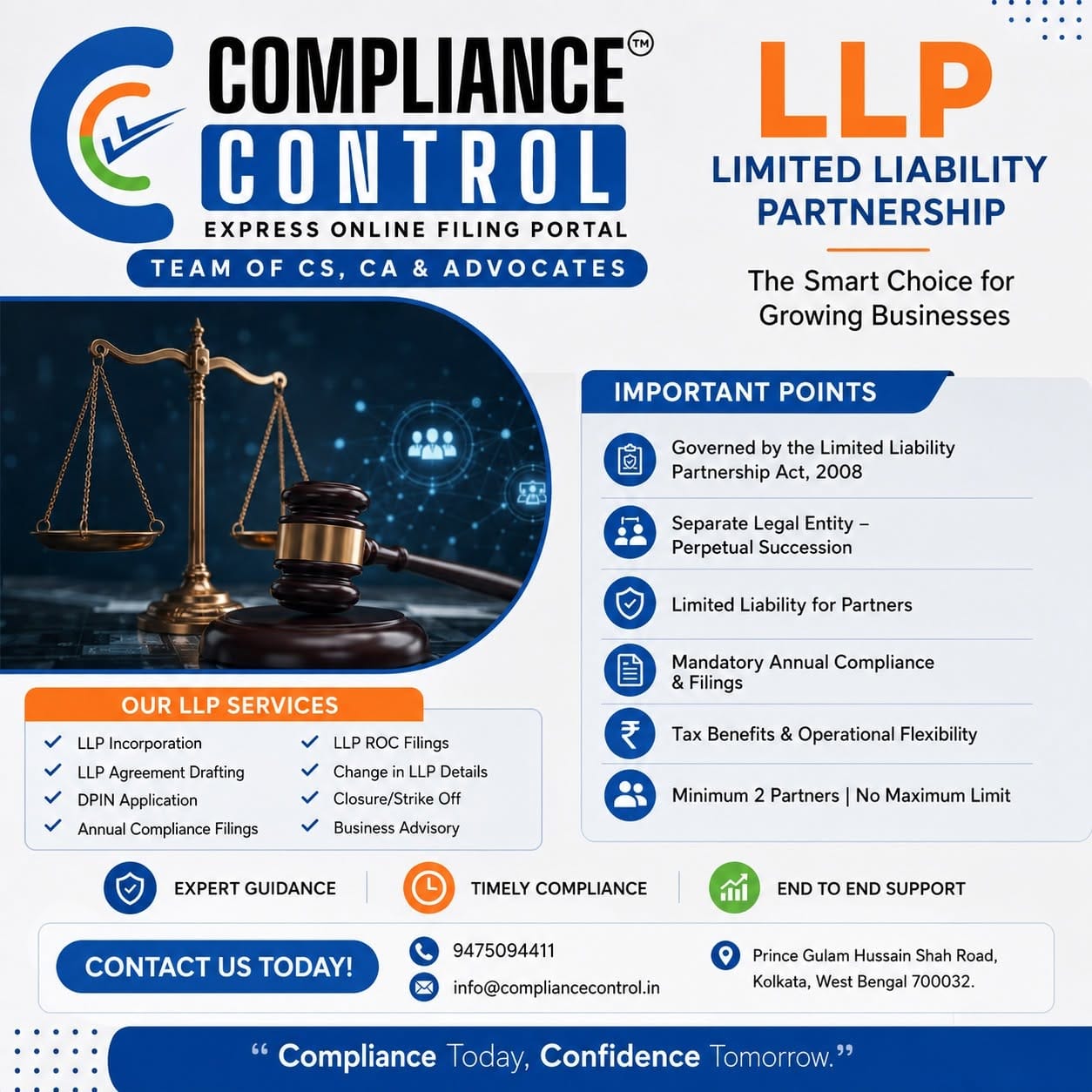
Starting a business is an exciting journey, but choosing the right business structure is one of the most important decisions entrepreneurs make. Among all business entities available in India, a Private Limited Company (Pvt Ltd) remains one of the most popular and trusted options for startups, SMEs, and growing businesses. A Private Limited Company offers a separate legal identity, limited liability protection, better credibility, and improved opportunities for investment and expansion. If you are planning to start a new venture, Private Limited Company Registration in India can provide a strong legal foundation for long-term business growth. Compliance Control helps entrepreneurs and business owners complete the registration process efficiently while ensuring compliance with regulatory requirements. What is a Private Limited Company? A Private Limited Company is a business entity registered under the Companies Act, 2013. It operates as a separate legal entity from its owners and provides limited liability protection to shareholders. Key Features ✔ Separate Legal Identity ✔ Limited Liability Protection ✔ Perpetual Succession ✔ Improved Business Credibility ✔ Easy Fundraising Opportunities ✔ Structured Business Operations This structure is widely preferred by startups, technology companies, service providers, manufacturers, consultants, and growing enterprises. Benefits of Private Limited Company Registration Limited Liability Protection The liability of shareholders is generally limited to the amount invested in the company. Personal assets are generally protected from business liabilities. Separate Legal Entity A Private Limited Company can own assets, enter contracts, sue, and be sued in its own name. Better Business Credibility Registered companies often enjoy greater trust among: Easy Fundraising Private Limited Companies can attract investors more easily compared to many other business structures. Perpetual Existence The company continues to exist regardless of changes in ownership or management. Eligibility for Private Limited Company Registration Generally, the following requirements apply: Minimum Directors At least 2 directors. Minimum Shareholders At least 2 shareholders. Registered Office Address A valid registered office address in India. Legal Compliance Compliance with applicable MCA requirements. Documents Required for Company Registration For Directors & Shareholders Registered Office Documents Document requirements may vary depending on specific circumstances and regulatory updates. Step-by-Step Process of Private Limited Company Registration Step 1 – Digital Signature Certificate (DSC) Digital signatures are required for electronic filing. Step 2 – Director Identification Number (DIN) DIN is required for company directors. Step 3 – Company Name Approval A unique company name is submitted for approval through MCA. Step 4 – Incorporation Filing Registration documents are filed with the Ministry of Corporate Affairs (MCA). Step 5 – Certificate of Incorporation Upon approval, the company receives its Certificate of Incorporation. Step 6 – PAN & TAN Allocation PAN and TAN are issued for tax-related compliance. Why Startups Prefer Private Limited Companies Startups often choose this structure because of: ✔ Investor Preference ✔ Professional Business Image ✔ Scalability ✔ Ownership Flexibility ✔ Better Growth Opportunities ✔ Strong Legal Framework This structure supports long-term expansion and investment opportunities. Importance of MCA Compliance After incorporation, companies must comply with various statutory requirements. Examples include: Annual Filing Submission of annual returns and financial statements. Director Compliance Maintaining director-related records and filings. Statutory Registers Maintaining required company records. ROC Compliance Regular filings with the Registrar of Companies. Compliance helps avoid penalties and legal complications. Additional Registrations Required After Incorporation Depending on business activities, companies may require: GST Registration For businesses meeting applicable GST criteria. MSME Registration For eligible micro, small, and medium enterprises. Trademark Registration To protect brand identity. Import Export Code (IEC) For international trade activities. Professional Tax Registration Where applicable. Common Mistakes During Company Registration Choosing an Inappropriate Business Structure The entity type should align with business goals. Incorrect Documentation Incomplete or inaccurate documents can delay registration. Non-Compliance After Incorporation Ignoring statutory obligations may result in penalties. Improper Shareholding Structure Planning ownership carefully is important for future growth. Why Choose Compliance Control? Compliance Control assists entrepreneurs and businesses with registration and compliance services designed to simplify the incorporation process. Services Include ✅ Private Limited Company Registration ✅ LLP Registration ✅ GST Registration ✅ MSME Registration ✅ Trademark Registration ✅ ROC Compliance ✅ Business Advisory Services Advantages of Working with Compliance Control Professional Guidance Expert assistance throughout the registration process. Timely Filing Efficient preparation and submission of documents. Compliance Support Ongoing regulatory assistance. End-to-End Service From registration to post-incorporation compliance. Transparent Process Clear guidance at every stage. Who Should Register a Private Limited Company? This structure is ideal for: Businesses seeking long-term growth often prefer this structure. Future Growth Opportunities A Private Limited Company supports: ✔ Business Expansion ✔ Investor Funding ✔ Strategic Partnerships ✔ Brand Building ✔ Market Credibility ✔ Long-Term Scalability The structure is designed to accommodate business growth over time. Conclusion Private Limited Company Registration is one of the most effective ways to establish a legally recognized and scalable business in India. With benefits such as limited liability, separate legal identity, improved credibility, and investment opportunities, it remains a preferred choice for startups and growing enterprises. If you are planning to start a business, Compliance Control can assist you with Private Limited Company Registration, compliance management, and business support services to help you build a strong foundation for future success. FAQ What is a Private Limited Company? A business entity registered under the Companies Act that provides limited liability protection and separate legal identity. How many directors are required? Generally, a minimum of two directors is required. Can startups register as a Private Limited Company? Yes, it is one of the most popular structures for startups. Is GST registration mandatory? GST requirements depend on business activities and turnover thresholds. Why choose Compliance Control? Compliance Control offers registration, compliance, advisory, and regulatory support services for businesses across India. #PrivateLimitedCompanyRegistration#CompanyRegistrationIndia#StartupRegistration#PvtLtdRegistration#BusinessRegistration#MCARegistration#ComplianceControl#GSTRegistration#MSMERegistration#TrademarkRegistration
Trademark Registration in Kolkata – Protect Your Brand Identity Legally
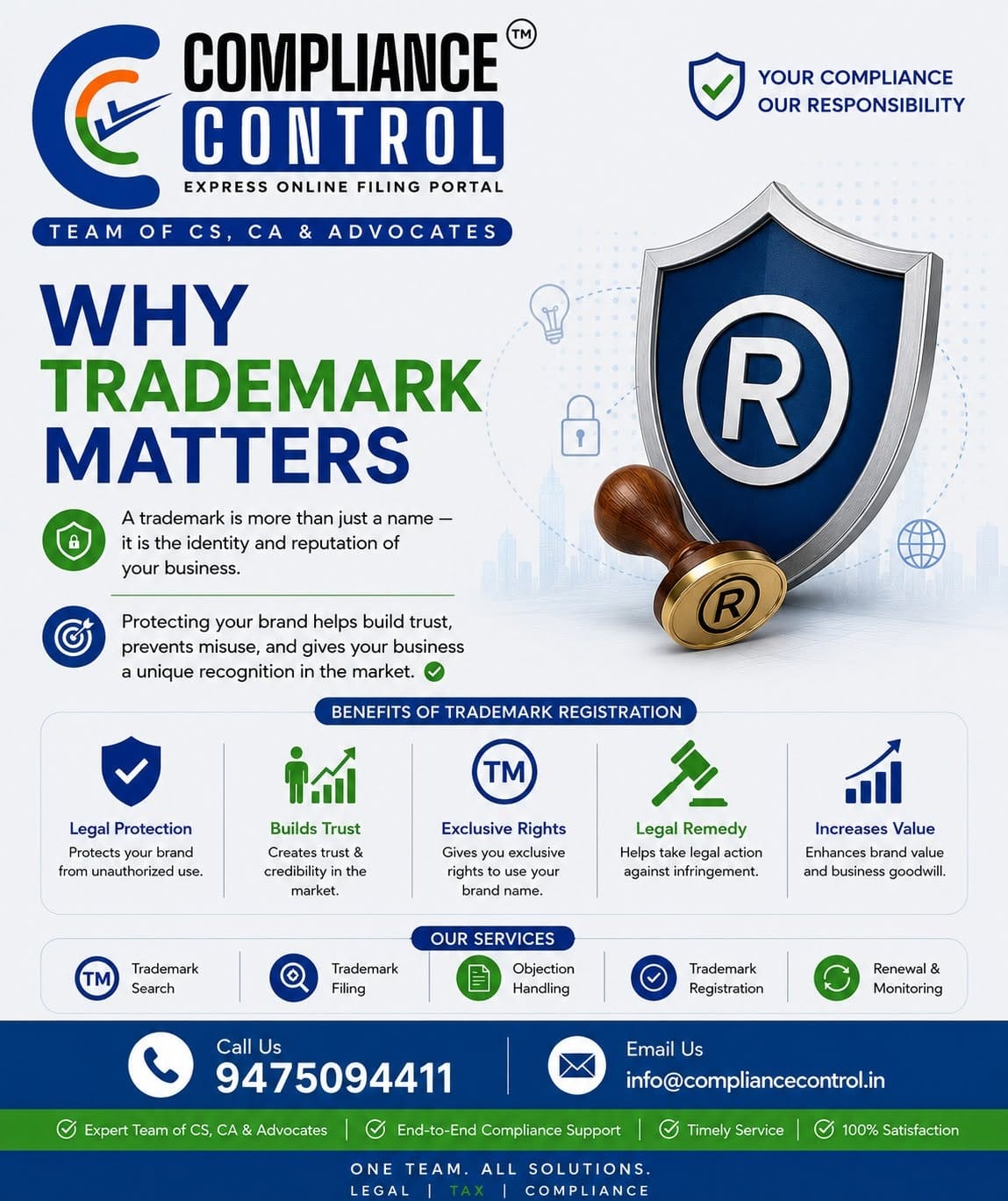
In today’s highly competitive business environment, your brand is one of your most valuable assets. Whether you own a startup, digital marketing agency, restaurant, manufacturing company, e-commerce business, consultancy firm, or retail store, protecting your business name and logo is essential. Many businesses invest years in building their reputation, customer trust, and brand recognition. Without trademark protection, there is always a risk that another person or company could use a similar name, logo, or brand identity. This is why Trademark Registration in Kolkata has become increasingly important for entrepreneurs and business owners looking to protect their intellectual property and secure their brand identity. Compliance Control provides professional trademark registration services designed to help businesses protect their valuable brands with a smooth and hassle-free process. What is a Trademark? A trademark is a unique sign, symbol, logo, brand name, phrase, word, design, or combination that distinguishes a business’s products or services from others in the marketplace. A trademark helps customers identify a particular brand and creates recognition in the market. Examples of trademarks include: ✔ Brand Names ✔ Business Names ✔ Company Logos ✔ Product Names ✔ Slogans ✔ Taglines ✔ Symbols ✔ Unique Designs A registered trademark becomes an important business asset. Why Trademark Registration is Important Many business owners assume that simply using a business name gives them ownership. However, legal protection generally comes through trademark registration. Brand Protection Trademark registration helps protect your brand identity from unauthorized use. Exclusive Rights The owner gains exclusive rights to use the registered trademark for specific goods or services. Legal Recognition A registered trademark strengthens your legal position in case of disputes. Brand Value A trademark can become a valuable business asset over time. Customer Trust Customers often associate registered brands with professionalism and credibility. Who Should Register a Trademark? Trademark registration is suitable for: Startups New businesses building a brand identity. Small Businesses Local businesses seeking legal protection. E-commerce Sellers Online businesses selling products nationwide. Digital Agencies Marketing, SEO, and branding companies. Manufacturers Businesses producing branded products. Restaurants & Cafes Food brands seeking market recognition. Consultants & Professionals Service-based businesses building a personal brand. Educational Institutions Training centers and coaching institutes. What Can Be Registered as a Trademark? Many types of business assets can be protected. Business Name The official business or brand name. Company Logo Unique visual identity of a business. Product Name Specific products sold under a brand. Tagline Marketing slogans and brand messages. Service Name Names used to identify services. Domain-Based Branding Certain brand-related digital assets may also form part of trademark protection strategies. Benefits of Trademark Registration Legal Ownership Trademark registration establishes ownership rights over the mark. Brand Recognition Helps consumers identify your products and services. Competitive Advantage Distinguishes your business from competitors. Business Expansion Facilitates future growth and franchising opportunities. Valuable Asset Creation A trademark can become an important intellectual property asset. Trademark Registration Process in India Step 1 – Trademark Search A search is conducted to identify potential conflicts with existing trademarks. Step 2 – Application Preparation The trademark application is prepared with relevant business details. Step 3 – Trademark Filing The application is submitted to the appropriate authority. Step 4 – Examination The application undergoes official review. Step 5 – Publication The trademark may be published according to applicable procedures. Step 6 – Registration Upon successful completion of the process, registration is granted. Documents Required for Trademark Registration Common documents may include: Individual Applicant Business Applicant Trademark Details Requirements may vary depending on applicant type. Trademark Classes Explained Trademark applications are filed under specific classes based on goods or services. Examples include: Class 35 Advertising, marketing, and business services. Class 42 Technology and software services. Class 25 Clothing and apparel. Class 30 Food products. Class 43 Restaurants and food services. Class 41 Education and training services. Selecting the correct class is important during registration. Common Trademark Registration Mistakes Many businesses face delays because of: ❌ Choosing a generic brand name ❌ Selecting the wrong trademark class ❌ Incomplete documentation ❌ Similarity with existing trademarks ❌ Filing errors Professional guidance helps reduce these risks. How Trademark Registration Helps Businesses Startups Creates a protected identity from the beginning. Digital Businesses Protects online branding efforts. Product Manufacturers Safeguards product branding and reputation. Service Providers Builds credibility and customer confidence. Growing Enterprises Supports future expansion and licensing opportunities. Trademark Registration vs Business Registration Many people confuse trademark registration with company registration. Company Registration Creates a legal business entity. Trademark Registration Protects the brand identity. Both serve different purposes and are often equally important. Importance of Intellectual Property Protection In today’s digital marketplace, brand duplication and imitation are common challenges. Trademark registration helps: ✔ Protect brand identity ✔ Strengthen business reputation ✔ Prevent confusion in the marketplace ✔ Support long-term business growth ✔ Create valuable intellectual property Businesses that invest in brand protection often enjoy stronger market positioning. Why Choose Compliance Control? Compliance Control provides professional trademark registration services with complete support throughout the process. Our Services Include ✅ Trademark Registration ✅ Brand Name Registration ✅ Logo Registration ✅ Intellectual Property Assistance ✅ Company Registration ✅ GST Registration ✅ MSME Registration Why Businesses Trust Compliance Control Experienced Professionals Guidance from knowledgeable experts. End-to-End Assistance Support throughout the registration journey. Transparent Process Clear communication at every stage. Affordable Service Packages Cost-effective solutions for businesses. Client-Focused Approach Dedicated support and personalized assistance. Future Importance of Trademark Protection As businesses increasingly operate online, protecting intellectual property becomes more critical. A strong trademark helps: Businesses that secure their trademarks early often avoid future legal and branding challenges. Conclusion Trademark registration is one of the smartest investments a business can make. It helps protect your brand identity, strengthens your legal position, and creates long-term business value. Whether you are launching a startup, building an e-commerce brand, running a digital marketing agency, or managing an established company, protecting your name and logo is essential. If you’re looking for Trademark Registration in Kolkata, Compliance Control offers professional, reliable, and hassle-free trademark registration services tailored to… Continue reading Trademark Registration in Kolkata – Protect Your Brand Identity Legally
FSSAI Registration in Kolkata – Complete Guide for Food Businesses
Starting a food-related business in India involves several legal and regulatory requirements. One of the most important registrations is obtaining an FSSAI License or FSSAI Registration. Whether you operate a restaurant, cloud kitchen, bakery, food manufacturing unit, grocery store, food delivery service, catering company, or food processing business, FSSAI registration helps establish legal compliance and builds customer trust. In today’s competitive market, consumers are becoming increasingly conscious about food quality and safety. An FSSAI certificate demonstrates that your business follows food safety standards and complies with applicable regulations. If you are looking for FSSAI Registration in Kolkata, Compliance Control offers professional support for obtaining your Food License quickly and efficiently. What is FSSAI Registration? FSSAI stands for the Food Safety and Standards Authority of India, which regulates food safety standards across the country. The authority is responsible for: Food businesses operating in India are generally required to obtain an FSSAI Registration or License based on their business category and operational scale. Why FSSAI Registration is Important Obtaining an FSSAI Registration offers several benefits for food businesses. Legal Authorization An FSSAI registration provides legal recognition for food-related operations. Builds Customer Trust Consumers often prefer purchasing food products from businesses that comply with recognized food safety standards. Enhances Brand Reputation An FSSAI-certified business appears more professional and trustworthy. Business Expansion Support Food businesses planning growth often require proper licensing and compliance. Better Market Opportunities Many distributors, suppliers, and marketplaces prefer working with licensed food businesses. Who Needs FSSAI Registration? Various food-related businesses may require FSSAI registration. Restaurants Restaurants serving food to customers. Cafes Coffee shops and beverage outlets. Cloud Kitchens Online food delivery businesses. Home-Based Food Businesses Small-scale food entrepreneurs. Food Manufacturers Companies involved in food production. Bakers & Confectioners Cake shops, bakeries, and dessert businesses. Grocery Stores Retail businesses selling food products. Food Importers & Exporters Businesses involved in international trade. Caterers Event and corporate catering services. Food Delivery Businesses Businesses involved in food distribution. Types of FSSAI Registration The type of registration depends on the nature and scale of the business. Basic FSSAI Registration Suitable for small food businesses and startups. Commonly used by: State FSSAI License Applicable to medium-sized food businesses operating within a state. Suitable for: Central FSSAI License Required for larger businesses operating across multiple states or engaged in large-scale food activities. Suitable for: Benefits of FSSAI Registration for Food Businesses Consumer Confidence Customers feel more secure purchasing food from registered businesses. Better Business Credibility Registration helps establish professionalism. Compliance with Regulations Helps businesses operate within applicable legal frameworks. Improved Market Access Registered businesses often find it easier to collaborate with distributors and marketplaces. Supports Long-Term Growth Provides a strong foundation for business expansion. Documents Required for FSSAI Registration Common documents may include: Identity Proof Business Information Address Proof Passport Size Photographs Recent photographs of the applicant. Additional Business Documents Depending on the business category. Requirements may vary according to business type and licensing category. Step-by-Step FSSAI Registration Process Step 1 – Consultation Review business requirements and determine the appropriate license category. Step 2 – Document Collection Gather required documents and business information. Step 3 – Application Preparation Complete and verify registration details. Step 4 – Submission Submit the application through the appropriate registration system. Step 5 – Verification Authorities review submitted information. Step 6 – Certificate Issuance Upon approval, the FSSAI Registration or License is issued. Common Businesses That Require FSSAI Registration Restaurants One of the most common categories requiring registration. Cloud Kitchens Online food businesses need proper compliance. Sweet Shops Food preparation and retail businesses. Catering Services Food supplied for events and functions. Food Manufacturers Production and packaging businesses. Grocery Stores Retailers selling packaged food products. Dairy Businesses Milk and dairy product sellers. Bakery Businesses Cakes, pastries, and baked product manufacturers. Importance of Food Safety Compliance Food safety is critical for maintaining customer trust. Businesses should focus on: ✔ Clean food preparation areas ✔ Proper food storage ✔ Quality control measures ✔ Hygiene standards ✔ Safe packaging practices ✔ Staff awareness and training These practices help support food safety objectives. Common Mistakes During FSSAI Registration Many businesses experience delays due to: ❌ Incorrect business details ❌ Incomplete documentation ❌ Wrong license category selection ❌ Application errors ❌ Lack of professional guidance Proper support can help avoid these issues. Why Choose Compliance Control for FSSAI Registration? Compliance Control provides professional assistance for food business registration and compliance requirements. Our Services Include ✅ FSSAI Registration ✅ FSSAI License Assistance ✅ Food Business Compliance ✅ Business Registration Support ✅ GST Registration ✅ Company Registration ✅ MSME Registration Why Businesses Trust Compliance Control Experienced Professionals Knowledgeable support throughout the process. Fast Processing Assistance Efficient documentation and application support. Affordable Pricing Cost-effective service packages. Transparent Communication Regular updates and clear guidance. End-to-End Support From application to certificate issuance. How FSSAI Registration Helps Business Growth Food businesses today face increasing competition. An FSSAI registration can help by: A properly registered food business is often viewed more favorably by customers and business partners. Future of Food Businesses in India India’s food industry continues to grow rapidly due to: Food businesses that focus on compliance and quality standards are better positioned for long-term success. Conclusion FSSAI Registration is an important step for food businesses seeking legal compliance, customer trust, and sustainable growth. Whether you operate a restaurant, bakery, catering service, cloud kitchen, grocery store, or food manufacturing unit, obtaining the appropriate FSSAI registration helps establish your business professionally. If you are looking for FSSAI Registration in Kolkata, Compliance Control offers reliable support, professional guidance, and hassle-free registration assistance to help your food business meet compliance requirements efficiently. FAQ What is FSSAI Registration? FSSAI Registration is the process of obtaining food business registration or licensing under the Food Safety and Standards Authority of India. Who needs FSSAI Registration? Food manufacturers, restaurants, caterers, cloud kitchens, grocery stores, bakeries, and other food-related businesses may require registration. Is FSSAI Registration mandatory? Requirements depend on the nature and scale of food business operations. How long does the… Continue reading FSSAI Registration in Kolkata – Complete Guide for Food Businesses
LLP Registration in India – Complete Guide for Entrepreneurs and Professionals
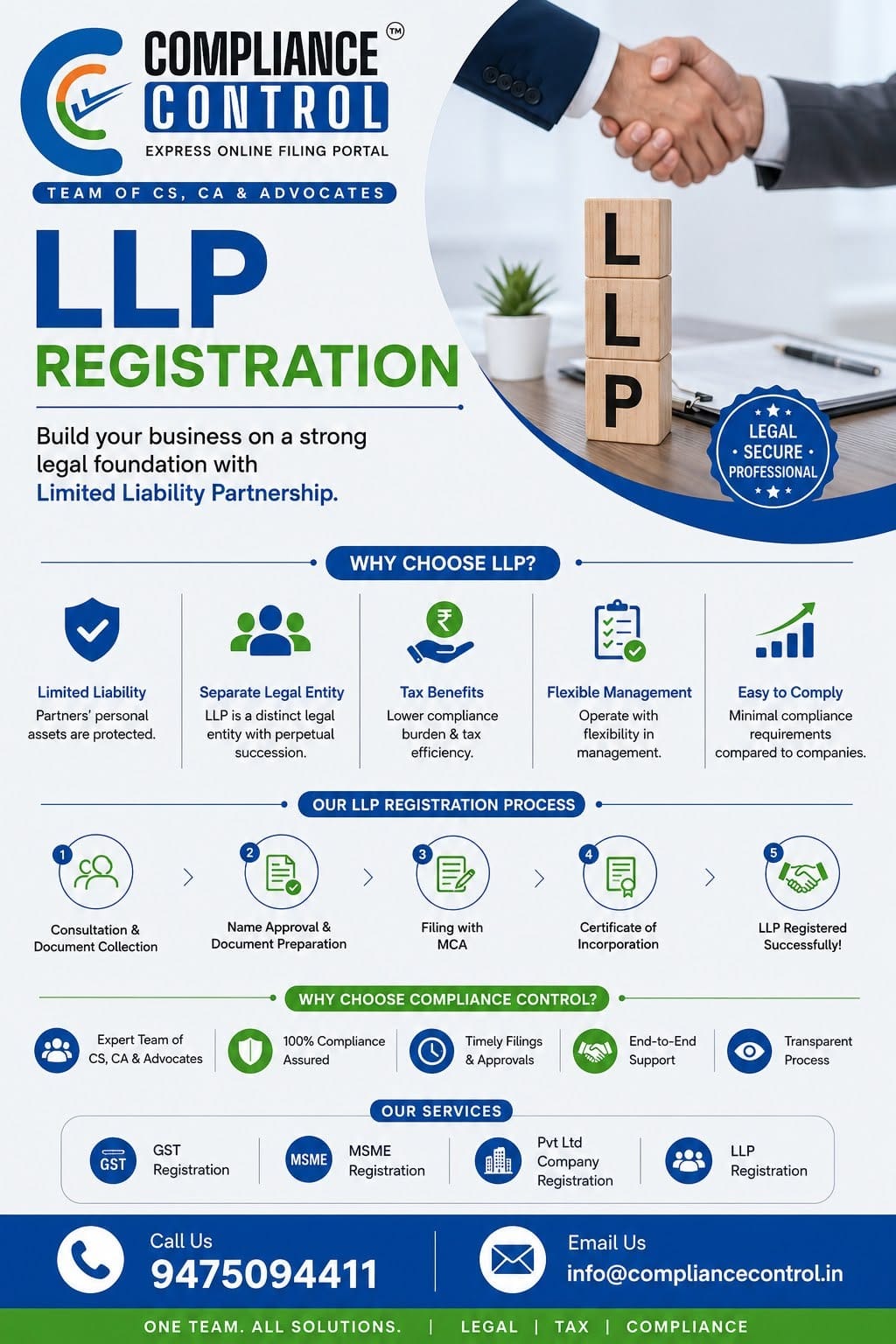
Choosing the right business structure is one of the most important decisions for any entrepreneur. Among the various business structures available in India, the Limited Liability Partnership (LLP) has become a preferred option for startups, consultants, agencies, professionals, and service-based businesses. An LLP combines the flexibility of a partnership with the benefits of limited liability protection. This unique combination makes it an attractive choice for businesses that want legal recognition without the extensive compliance requirements often associated with companies. Whether you are starting a consultancy, digital marketing agency, IT company, legal practice, accounting firm, or professional service business, LLP registration can provide a strong foundation for growth. What is an LLP? A Limited Liability Partnership (LLP) is a legal business structure governed by the Limited Liability Partnership Act. An LLP combines features of: ✔ Traditional Partnership ✔ Corporate Structure ✔ Limited Liability Protection ✔ Operational Flexibility In an LLP, partners generally have limited liability protection while retaining flexibility in managing business operations. Why LLP Registration is Popular in India Many entrepreneurs choose LLP registration because it offers a balance between flexibility and legal protection. Limited Liability Protection Partners’ liability is generally limited to their agreed contribution. Separate Legal Entity The LLP exists independently from its partners. Professional Credibility A registered LLP enhances business reputation. Operational Flexibility Partners can define management structures through an LLP agreement. Continuous Existence The LLP can continue despite changes in partners. Who Should Register an LLP? LLP registration is ideal for: Consultants Business consultants and advisors. Chartered Accountants Professional accounting firms. Lawyers Legal professionals and law firms. Digital Marketing Agencies Marketing and advertising businesses. IT Service Providers Technology and software companies. Freelancers Professionals seeking a formal business structure. Startups Businesses requiring flexibility and legal recognition. Benefits of LLP Registration 1. Limited Liability One of the biggest advantages of an LLP is liability protection for partners. This helps reduce personal financial exposure related to business obligations. 2. Professional Business Image Clients and vendors often prefer working with registered business entities. 3. Flexible Management Partners can establish operational guidelines through mutual agreements. 4. Separate Legal Identity The LLP can own assets and enter contracts in its own name. 5. Business Continuity Changes in partnership do not necessarily affect business existence. Documents Required for LLP Registration Identity Proof Address Proof Registered Office Proof Additional Information LLP Registration Process Step 1: Digital Signature Certificate (DSC) Digital signatures are required for online filing. Step 2: Director/Partner Identification Relevant identification requirements are completed. Step 3: Name Reservation A unique LLP name is selected and submitted. Step 4: Incorporation Filing Registration documents are submitted to the authorities. Step 5: LLP Certificate Issuance Upon approval, the LLP receives official registration. LLP vs Private Limited Company Many entrepreneurs compare LLPs with Private Limited Companies. LLP ✔ Flexible Management ✔ Partnership-Based Structure ✔ Suitable for Professionals ✔ Moderate Compliance Private Limited Company ✔ Investor-Friendly Structure ✔ Share-Based Ownership ✔ Suitable for Scaling Businesses ✔ More Formal Corporate Structure The choice depends on business goals and future plans. Common LLP Registration Mistakes Choosing an Inappropriate Name Select a unique and compliant business name. Documentation Errors Ensure all submitted documents are accurate. Delayed Registration Register early to establish legal identity. Ignoring Compliance Requirements Understand ongoing obligations after registration. Why Startups Choose LLP Registration Startups often prefer LLPs because they offer: ✔ Legal Recognition ✔ Limited Liability ✔ Professional Credibility ✔ Flexible Operations ✔ Cost-Effective Structure Many service-based startups find LLPs particularly suitable during initial growth phases. Importance of LLP Compliance After registration, LLPs should maintain proper compliance practices. These may include: Annual Filings Maintaining required records. Financial Documentation Keeping accurate business accounts. Regulatory Compliance Meeting applicable legal obligations. Proper compliance helps maintain business credibility and avoid unnecessary complications. Why Choose Professional LLP Registration Services? Professional consultants help entrepreneurs: ✔ Prepare Documentation ✔ Complete Registration Efficiently ✔ Reduce Filing Errors ✔ Provide Expert Guidance ✔ Support Future Compliance This allows business owners to focus on growing their business. Why Choose Compliance Control? Compliance Control provides comprehensive business registration and compliance solutions for entrepreneurs, professionals, and startups. Services Offered ✅ LLP Registration ✅ Private Limited Company Registration ✅ GST Registration ✅ Trademark Registration ✅ MSME Registration ✅ Startup Registration ✅ Annual Compliance Services Why Businesses Trust Compliance Control ✔ Expert Team ✔ Fast Processing ✔ Affordable Pricing ✔ End-to-End Support ✔ Professional Guidance ✔ Business Compliance Solutions Conclusion LLP Registration is an excellent option for professionals, consultants, agencies, and startups seeking legal recognition, liability protection, and operational flexibility. With its balanced structure and professional credibility, an LLP can serve as a strong foundation for long-term business growth. Compliance Control helps entrepreneurs complete LLP registration smoothly while providing ongoing support for business compliance and success. 🏢 LLP Registration in India – Start Your Business Professionally Looking for LLP Registration services? Compliance Control helps startups, professionals, consultants, and businesses register LLPs quickly and efficiently. Our Services ✅ LLP Registration ✅ GST Registration ✅ Trademark Registration ✅ Company Registration ✅ MSME Registration ✅ Compliance Services Why Choose Compliance Control? ✔ Expert Guidance ✔ Fast Processing ✔ Affordable Pricing ✔ Professional Support ✔ End-to-End Assistance 📞 Contact Compliance Control Today 🌐 Register Your LLP Online llp registration india, limited liability partnership registration, llp registration online, llp incorporation india, business registration india, startup registration, llp compliance, online llp registration, compliance control, llp formation #LLPRegistration#LimitedLiabilityPartnership#BusinessRegistration#StartupIndia#ComplianceControl#Entrepreneurship#CompanyRegistration#GSTRegistration#TrademarkRegistration#MSMERegistration#BusinessGrowth#ProfessionalServices#BusinessConsulting#OnlineRegistration#StartupBusiness#LegalCompliance#BusinessOwner#IndianStartups#CorporateServices#BusinessSuccess#BusinessSetup#DigitalBusiness#StartupJourney#BusinessSupport#FinancialGrowth#ComplianceServices#LLPIndia#BusinessDevelopment#ProfessionalBusiness#LegalServices
MSME Registration Online in India – The Ultimate Guide for Small Businesses, Startups, and Entrepreneurs
India is one of the fastest-growing economies in the world, and a significant portion of its economic growth comes from Micro, Small, and Medium Enterprises (MSMEs). These businesses contribute substantially to employment generation, exports, innovation, and industrial development. Whether you run a manufacturing unit, service-based company, digital marketing agency, consultancy firm, trading business, startup, or online business, obtaining MSME Registration can provide numerous advantages that support business growth and long-term success. The Government of India introduced the Udyam Registration system to simplify the MSME registration process and make it easier for entrepreneurs to access various government benefits. Today, MSME registration is considered one of the most important registrations for small and medium businesses looking to improve credibility, access funding, and benefit from government schemes. In this comprehensive guide, we’ll explore everything you need to know about MSME Registration Online in India. What is MSME Registration? MSME stands for Micro, Small, and Medium Enterprises. Businesses that meet specific investment and turnover criteria can register as MSMEs under the Udyam Registration system. The purpose of MSME registration is to: MSME registration serves as an official recognition of your business by the Government of India. Why MSME Registration is Important Many business owners focus only on GST registration and company registration while overlooking MSME registration. However, MSME registration offers multiple advantages that can significantly benefit businesses. Benefits include: ✔ Government Recognition ✔ Better Access to Loans ✔ Business Credibility ✔ Financial Support ✔ Subsidies and Incentives ✔ Tender Opportunities ✔ Easier Licensing ✔ Growth Assistance Benefits of MSME Registration 1. Easier Access to Business Loans One of the biggest advantages of MSME registration is improved access to business financing. Many banks and financial institutions offer special loan schemes for MSMEs. Benefits include: 2. Government Subsidies Registered MSMEs may become eligible for various government support programs. These schemes often focus on: 3. Improved Business Credibility An MSME certificate helps establish your business as a recognized enterprise. Customers, suppliers, and financial institutions often view registered businesses as more trustworthy. 4. Participation in Government Tenders Many government tenders provide special benefits and opportunities for MSMEs. This can help businesses secure valuable contracts. 5. Protection Against Delayed Payments MSME-registered businesses receive certain protections regarding delayed payments from buyers. This helps improve cash flow management. 6. Easier Approval for Licenses and Registrations Government approvals often become smoother for registered MSMEs. 7. Tax and Business Benefits Various schemes and incentives may be available to support business growth and competitiveness. Who Should Apply for MSME Registration? MSME registration is beneficial for: Startups Build credibility from the beginning. Private Limited Companies Access government benefits and funding opportunities. LLPs Strengthen business recognition. Sole Proprietorships Gain official recognition. Partnership Firms Improve credibility and growth opportunities. Freelancers Certain professional service providers may benefit. Digital Marketing Agencies Access government schemes and financial opportunities. IT Companies Strengthen business credentials. Manufacturers Benefit from industry-specific programs. Traders Improve access to business support. MSME Classification Businesses are classified based on investment and annual turnover criteria. Categories include: Micro Enterprises Small-scale businesses with lower investment and turnover. Small Enterprises Growing businesses with moderate scale operations. Medium Enterprises Larger enterprises within the MSME framework. The government periodically updates these classifications. Documents Required for MSME Registration The registration process is relatively simple. Common requirements include: Aadhaar Card For business owner verification. PAN Card Required for identification and tax compliance. Business Details Bank Information GST Information If applicable. Step-by-Step MSME Registration Process Step 1: Gather Documents Prepare all required information and documents. Step 2: Verify Business Details Ensure consistency across registrations. Step 3: Submit Application Complete the online registration process. Step 4: Verification Authorities verify submitted information. Step 5: Udyam Certificate Issuance Upon approval, the MSME/Udyam Registration Certificate is generated. Common MSME Registration Mistakes Many businesses encounter delays because of: Incorrect PAN Details Wrong Business Information Mismatched GST Data Incomplete Documentation Incorrect Business Classification Professional guidance helps avoid these issues. MSME Registration for Startups Startups benefit significantly from MSME registration. Advantages include: ✔ Improved Credibility ✔ Easier Funding Access ✔ Government Support ✔ Better Business Opportunities ✔ Long-Term Growth Support For many startups, MSME registration becomes an important step toward business expansion. MSME Registration for Digital Businesses Modern digital businesses can also benefit. Examples include: MSME registration helps improve business credibility and access opportunities. MSME Registration and Business Growth As businesses grow, access to resources becomes increasingly important. MSME registration can support: Business Expansion Equipment Purchases Technology Upgrades Workforce Development Market Expansion Government Opportunities Why Choose Compliance Control? Compliance Control provides complete business registration and compliance solutions. Services include: ✔ MSME Registration ✔ GST Registration ✔ Company Registration ✔ LLP Registration ✔ Trademark Registration ✔ IEC Registration ✔ FSSAI Registration ✔ ROC Compliance ✔ Annual Filing ✔ Business Compliance Services Professional assistance helps simplify registration while reducing errors and delays. Conclusion MSME Registration is one of the most valuable registrations available for small businesses, startups, entrepreneurs, and growing companies in India. From easier access to financing and government benefits to improved credibility and business opportunities, MSME registration provides numerous advantages that support long-term success. If you’re serious about growing your business, MSME registration should be a priority. Register your MSME today and unlock new opportunities for growth and success. 🚀 MSME Registration Online – Grow Your Business with Government Recognition Looking to register your business as an MSME? Compliance Control helps startups, entrepreneurs, LLPs, Private Limited Companies, and small businesses obtain MSME/Udyam Registration quickly and efficiently. Our Services Include: ✅ MSME Registration ✅ Udyam Registration ✅ GST Registration ✅ Company Registration ✅ Trademark Registration ✅ LLP Registration ✅ Business Compliance Services Why Choose Compliance Control? ✔ Expert Support ✔ Fast Processing ✔ Affordable Pricing ✔ PAN India Services ✔ Complete Business Solutions 📞 Contact Compliance Control Today 🌐 Start Your MSME Registration Online msme registration online, udyam registration online, msme registration india, udyam certificate, startup registration india, small business registration, msme benefits, government registration for business, msme consultant india, udyam registration consultant, compliance control, business registration india, msme loan benefits, startup compliance… Continue reading MSME Registration Online in India – The Ultimate Guide for Small Businesses, Startups, and Entrepreneurs
GST Registration Online in India – The Ultimate Guide for Business Owners, Startups & Entrepreneurs
India’s business ecosystem has undergone significant transformation over the last decade. One of the most important reforms introduced by the Government of India was the implementation of Goods and Services Tax (GST). GST replaced multiple indirect taxes with a unified taxation system, making tax compliance simpler and more transparent for businesses. Today, GST Registration is one of the most important legal requirements for businesses operating in India. Whether you are a startup founder, freelancer, digital marketer, consultant, eCommerce seller, trader, manufacturer, service provider, LLP, or Private Limited Company, understanding GST registration is essential for running a compliant and successful business. Many entrepreneurs delay GST registration due to confusion about eligibility, documentation, compliance, and filing procedures. However, obtaining a GST number can provide numerous advantages that support business growth and credibility. In this comprehensive guide, you’ll learn everything about GST Registration Online in India, including benefits, eligibility criteria, documents required, registration process, compliance requirements, and why professional assistance can make the process easier. What is GST? GST stands for Goods and Services Tax. It is a destination-based indirect tax system that applies to the supply of goods and services across India. GST was introduced to simplify taxation by replacing multiple taxes such as: The GST system helps create a unified national market and reduces tax complexity. Why GST Registration is Important GST registration is more than just a legal formality. It helps businesses: ✔ Operate Legally ✔ Improve Credibility ✔ Claim Input Tax Credit ✔ Expand Business Operations ✔ Sell on Online Marketplaces ✔ Build Trust with Customers ✔ Participate in Government Tenders ✔ Avoid Legal Penalties A registered business is generally viewed as more professional and trustworthy. Benefits of GST Registration 1. Legal Recognition of Your Business A GST registration certificate establishes your business as a legally recognized entity under India’s taxation system. This increases customer confidence and improves market reputation. 2. Input Tax Credit (ITC) One of the biggest advantages of GST registration is the ability to claim Input Tax Credit. Businesses can offset taxes paid on purchases against taxes collected on sales. This helps reduce overall tax burden. 3. Easier Business Expansion GST registration enables businesses to operate more efficiently across multiple states. It supports growth and scalability. 4. Sell on eCommerce Platforms Major online marketplaces often require GST registration from sellers. This makes GST essential for: 5. Increased Business Credibility Clients and vendors often prefer dealing with GST-registered businesses. It demonstrates professionalism and compliance. 6. Government Tender Eligibility Many government projects and tenders require GST registration. This creates additional business opportunities. Who Needs GST Registration? GST registration may be required for: Startups Private Limited Companies LLPs Sole Proprietors Partnership Firms Consultants Freelancers Service Providers Online Sellers Import Export Businesses Agencies Manufacturers Traders Eligibility requirements can vary based on turnover thresholds and business activities. Documents Required for GST Registration Individual Applicants Business Address Proof Bank Details Company Documents Step-by-Step GST Registration Process Step 1: Document Collection Gather all required documents. Step 2: Application Preparation Prepare GST registration application. Step 3: Online Submission Submit details through the GST portal. Step 4: Verification Process Authorities review submitted information. Step 5: GSTIN Generation Upon approval, the GST Identification Number (GSTIN) is issued. Step 6: GST Certificate Issuance Business receives GST Registration Certificate. Common GST Registration Mistakes Many businesses face delays due to: Incorrect PAN Details Wrong Business Address Incomplete Documentation Incorrect Business Classification Mismatched Information Professional assistance helps reduce these errors. GST Registration for Startups Startups benefit significantly from GST registration. Advantages include: ✔ Improved Business Credibility ✔ Easier Vendor Relationships ✔ Input Tax Credit Benefits ✔ Investor Confidence ✔ Better Compliance As startups grow, GST compliance becomes increasingly important. GST Registration for Digital Businesses Digital businesses often require GST registration. Examples include: GST helps establish legal compliance and professional credibility. GST Compliance After Registration Obtaining GST registration is only the beginning. Businesses must also ensure ongoing compliance. Important activities include: GST Return Filing Record Maintenance Invoice Management Tax Payment Compliance Monitoring Regular compliance helps avoid penalties. Why Choose Compliance Control? Compliance Control assists businesses with: ✔ GST Registration ✔ GST Filing ✔ Company Registration ✔ LLP Registration ✔ Trademark Registration ✔ MSME Registration ✔ FSSAI Registration ✔ IEC Registration ✔ ROC Compliance ✔ Annual Filing Professional support simplifies registration and compliance management. Conclusion GST Registration is one of the most important steps for building a legally compliant and credible business in India. Whether you are a startup founder, freelancer, consultant, online seller, LLP, or Private Limited Company, GST registration helps create a strong foundation for long-term growth. Register your GST today and take the next step toward building a successful and compliant business. GST Registration Online – Start Your Business the Right Way Need GST Registration for your business? Compliance Control helps startups, companies, freelancers, and entrepreneurs obtain GST Registration quickly and efficiently. Our Services Include: ✅ GST Registration ✅ GST Filing ✅ Company Registration ✅ LLP Registration ✅ MSME Registration ✅ Trademark Registration ✅ ROC Compliance Why Choose Us? ✔ Expert Guidance ✔ Affordable Pricing ✔ Fast Processing ✔ PAN India Service ✔ Complete Compliance Support 📞 Contact Compliance Control Today 🌐 Register Your Business Online gst registration online, gst registration india, apply gst online, gst consultant india, gst number registration, online gst registration, gst filing services, startup gst registration, business gst registration, gst compliance services, gst registration consultant, compliance control, gst registration kolkata, gst services india #GSTRegistration#GSTRegistrationOnline#GSTIndia#GSTConsultant#GSTFiling#BusinessRegistration#CompanyRegistration#StartupIndia#PrivateLimitedCompany#LLPRegistration#MSMERegistration#TrademarkRegistration#BusinessCompliance#TaxConsultant#ComplianceServices#OnlineBusiness#EntrepreneurIndia#BusinessGrowth#ProfessionalServices#GSTServices#ComplianceControl#IndiaBusiness#DigitalBusiness#StartupBusiness#ROCCompliance#BusinessConsultant#LegalServices#BusinessSuccess#OnlineRegistration#TaxCompliance
Trademark Registration in India – The Ultimate Guide to Protecting Your Brand, Business Identity, and Future Growth
In today’s highly competitive business world, building a strong brand is no longer optional—it is essential. Whether you own a startup, MSME, eCommerce business, LLP, Private Limited Company, consultancy firm, digital marketing agency, manufacturing business, or service-based organization, your brand is one of your most valuable assets. Customers identify your business through your brand name, logo, tagline, packaging, and online presence. However, many businesses spend years building their reputation without legally protecting their brand identity. Imagine investing thousands or even lakhs of rupees in marketing, SEO, social media promotion, website development, and customer acquisition only to discover that someone else has copied your brand name or logo. This is where Trademark Registration becomes critical. Trademark registration provides legal ownership of your brand identity and protects your business from unauthorized use, duplication, and infringement. In India, trademark protection is governed under the Trade Marks Act, helping businesses secure their intellectual property and establish long-term brand value. Whether you’re launching a new startup or growing an established company, trademark registration should be one of your top priorities. What is a Trademark? A trademark is a unique sign, word, logo, phrase, symbol, design, or combination used to identify and distinguish a business’s products or services from competitors. A trademark acts as your business identity in the marketplace. Examples of trademarks include: Brand Names Amazon Flipkart Zomato Swiggy Logos Company symbols and visual identities. Taglines Unique marketing slogans. Product Names Names used for specific products or services. Labels and Packaging Distinctive packaging designs. Once registered, the trademark becomes a valuable intellectual property asset. Why Trademark Registration is Important Many entrepreneurs underestimate the importance of trademark protection until they face legal disputes. Trademark registration helps: ✔ Protect Brand Identity ✔ Prevent Unauthorized Use ✔ Build Customer Trust ✔ Increase Business Value ✔ Create Legal Ownership ✔ Support Business Expansion ✔ Improve Brand Recognition ✔ Enhance Investor Confidence Without trademark registration, your brand remains vulnerable to misuse by competitors. Understanding Brand Protection in Modern Business Today’s customers interact with businesses through multiple channels: As your brand visibility grows, so does the risk of imitation. A registered trademark acts as a legal shield that protects your business identity. Benefits of Trademark Registration 1. Exclusive Ownership Rights Trademark registration grants exclusive rights to use the mark for specific goods and services. This means competitors cannot legally use a confusingly similar trademark. 2. Legal Protection One of the biggest advantages of trademark registration is legal protection. If another business copies your name or logo, registration provides stronger legal grounds for enforcement. 3. Builds Brand Credibility Customers tend to trust professionally managed brands. A registered trademark demonstrates seriousness, professionalism, and commitment to quality. 4. Creates a Valuable Business Asset A trademark is not just a legal certificate. It is an intellectual property asset that can increase in value as your business grows. Many global companies derive significant value from their trademarks. 5. Helps Attract Investors Investors often evaluate: A registered trademark enhances business credibility and investor confidence. 6. Protects Marketing Investments Businesses invest heavily in: Trademark protection safeguards these investments. 7. Supports Franchise Expansion Businesses planning to expand through franchise models require strong brand protection. Trademark registration helps establish legal ownership before expansion. 8. Prevents Competitor Misuse Without registration, competitors may attempt to: Trademark registration significantly reduces these risks. Who Should Register a Trademark? Trademark registration is suitable for: Startups Protect your brand from day one. Private Limited Companies Secure long-term brand ownership. LLPs Build a legally protected identity. MSMEs Increase credibility and market value. eCommerce Businesses Protect online brands and product names. Consultants Secure professional branding. Agencies Protect creative and service-based brands. Manufacturers Protect product labels and packaging. Import Export Businesses Maintain brand consistency across markets. What Can Be Registered as a Trademark? Many business elements qualify for trademark protection. Business Name Your company or brand identity. Logo Visual representation of your business. Tagline Unique marketing phrase. Product Name Specific product branding. Service Name Service-specific identity. Packaging Design Distinctive product appearance. Label Design Visual product presentation. Documents Required for Trademark Registration The documentation process is generally straightforward. Individual Applicant Company Applicant LLP Applicant Additional Documents Step-by-Step Trademark Registration Process Step 1: Trademark Search A professional search identifies similar trademarks already registered. This helps reduce rejection risks. Step 2: Class Selection Trademark classes categorize products and services. Selecting the correct class is essential. Step 3: Application Filing The trademark application is submitted with all necessary details. Step 4: Examination Authorities review the application and may issue examination reports. Step 5: Objection Response If objections arise, professional responses may be required. Step 6: Publication The trademark is published for public review. Step 7: Registration Certificate Upon successful completion, the trademark is officially registered. Common Trademark Registration Mistakes Many businesses encounter delays because of: Incorrect Class Selection Can result in inadequate protection. Generic Brand Names Generic names are difficult to protect. Lack of Trademark Search May cause avoidable objections. Incomplete Documentation Delays processing. DIY Filing Errors Professional guidance often prevents costly mistakes. Why Startups Should Prioritize Trademark Registration Startups often focus on: However, brand protection is equally important. Benefits include: ✔ Brand Security ✔ Investor Confidence ✔ Market Differentiation ✔ Legal Protection ✔ Business Scalability Trademark Registration and SEO Your brand name becomes increasingly important as your website gains visibility. Trademark registration helps protect: Website Identity Domain Reputation SEO Authority Content Marketing Efforts Online Brand Presence A protected brand supports long-term digital growth. Trademark Registration and Google Business Profile Businesses investing in Google Business Profile optimization benefit from trademark protection. Benefits include: This is particularly important for local businesses competing in crowded markets. Why Choose Compliance Control? Compliance Control helps businesses with: ✔ Trademark Registration ✔ Company Registration ✔ GST Registration ✔ LLP Registration ✔ MSME Registration ✔ FSSAI Registration ✔ IEC Registration ✔ ROC Compliance ✔ Annual Filing ✔ Business Compliance Solutions Professional support helps simplify the registration process and minimize errors. Conclusion Your brand is one of the most valuable assets your business will ever own. Trademark Registration provides… Continue reading Trademark Registration in India – The Ultimate Guide to Protecting Your Brand, Business Identity, and Future Growth