
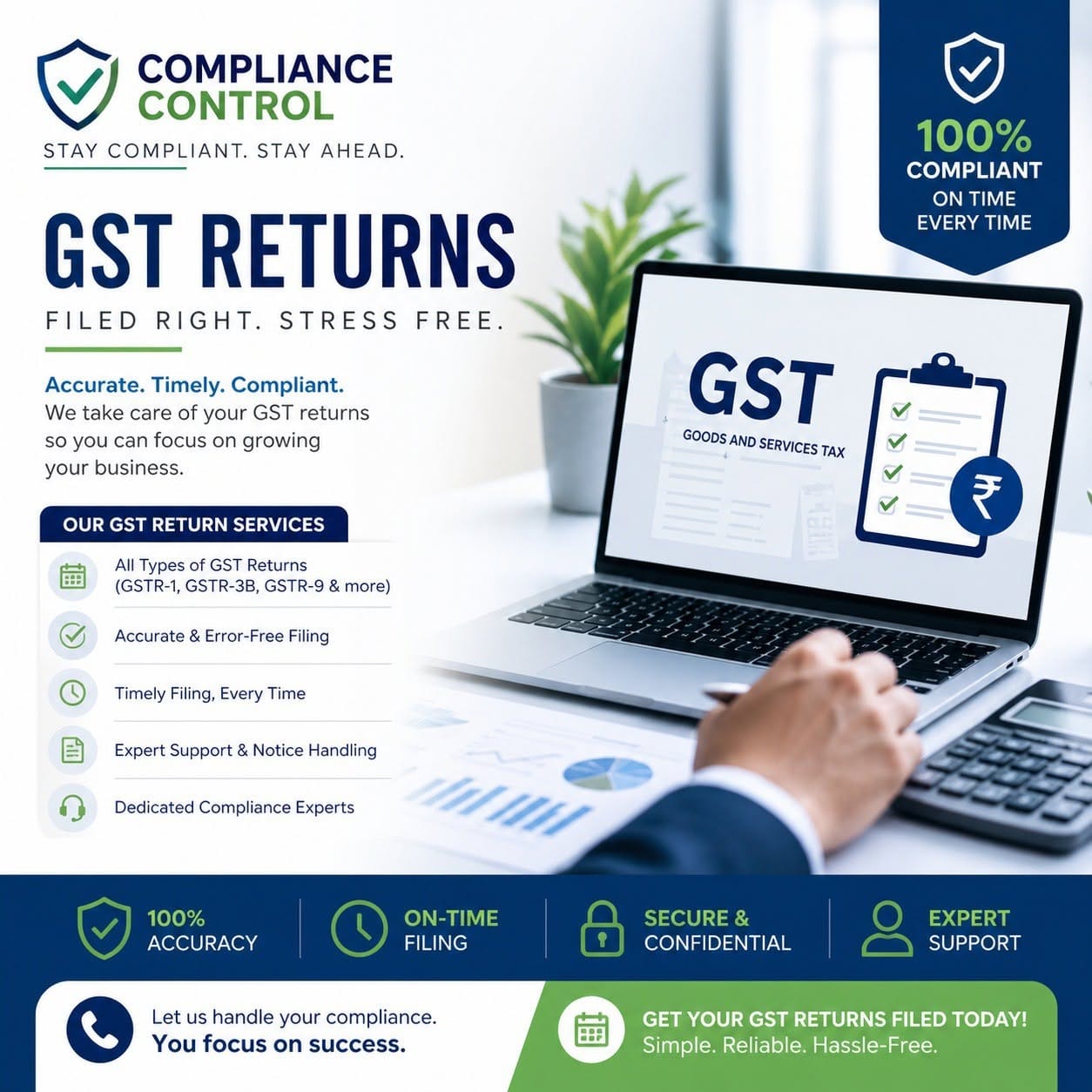
The introduction of Goods and Services Tax (GST) has revolutionized the taxation system in India by replacing multiple indirect taxes with a single, unified tax structure. GST has simplified business operations, increased transparency, and created a streamlined tax environment for businesses across the country.
Whether you are a startup, freelancer, trader, manufacturer, e-commerce seller, consultant, or service provider, GST registration plays a crucial role in maintaining legal compliance and ensuring smooth business operations.
Many businesses today require GST registration not only for compliance purposes but also to improve credibility, participate in government tenders, work with corporate clients, and claim input tax credits.
If you are planning to start a business or expand your operations, understanding GST registration is essential. Compliance Control provides professional GST registration and compliance services to help businesses remain legally compliant while focusing on growth and profitability.
What is GST?
GST (Goods and Services Tax) is a comprehensive indirect tax imposed on the supply of goods and services throughout India.
Introduced on 1st July 2017, GST replaced various indirect taxes such as:
- VAT
- Service Tax
- Excise Duty
- Central Sales Tax
- Entry Tax
- Luxury Tax
- Entertainment Tax
The primary objective of GST is to create a unified national market and simplify taxation procedures.
Why GST Registration is Important
GST registration is more than just a legal requirement.
It offers several advantages that contribute to business growth and credibility.
Benefits include:
✔ Legal Recognition
✔ Tax Compliance
✔ Input Tax Credit Benefits
✔ Better Business Opportunities
✔ Expansion Across States
✔ Increased Credibility
✔ Easier Loan Processing
✔ Participation in Government Tenders
A GST-registered business often appears more trustworthy to customers and business partners.
Benefits of GST Registration
Legal Authorization to Collect GST
Businesses registered under GST can legally collect GST from customers.
This ensures compliance with tax regulations and prevents legal complications.
Input Tax Credit (ITC)
One of the biggest advantages of GST registration is the ability to claim Input Tax Credit.
This allows businesses to reduce their tax burden by claiming credit for GST paid on purchases and expenses.
Benefits include:
- Reduced tax liability
- Improved cash flow
- Lower operating costs
Increased Business Credibility
Many customers prefer dealing with GST-registered businesses because it indicates professionalism and legal compliance.
Corporate clients often require GST registration before awarding contracts.
Interstate Business Operations
GST registration facilitates smooth interstate trade without many of the complexities that existed before GST implementation.
E-Commerce Selling
Many online marketplaces require sellers to possess GST registration.
This is especially important for businesses selling through online platforms.
Improved Banking & Funding Opportunities
GST-compliant businesses often find it easier to obtain:
- Business Loans
- Working Capital Financing
- Investor Funding
Financial institutions frequently consider GST records during evaluations.
Who Should Apply for GST Registration?
Various categories of businesses may require GST registration.
Service Providers
Consultants, agencies, professionals, and service providers often need GST registration depending on turnover and business activities.
Examples include:
- Digital Marketing Agencies
- IT Companies
- Interior Designers
- Architects
- Consultants
Traders
Businesses engaged in buying and selling products may require GST registration.
Manufacturers
Manufacturing companies often require GST registration for tax compliance and business operations.
E-Commerce Sellers
Businesses selling through online marketplaces frequently require GST registration.
Startups
Startups often obtain GST registration early to establish credibility and facilitate future growth.
Freelancers
Many freelancers working with domestic and international clients choose GST registration for professional operations.
GST Registration Threshold Limits
GST registration requirements depend on various factors, including turnover, business activities, and applicable regulations.
Businesses should regularly verify current thresholds and requirements through professional consultation and official government notifications.
Compliance Control assists businesses in understanding their GST obligations based on their specific circumstances.
Types of GST Registration
Normal Taxpayer Registration
Suitable for most businesses operating in India.
Composition Scheme Registration
Designed for eligible small businesses seeking simplified tax compliance.
Casual Taxable Person Registration
Applicable to businesses operating temporarily in specific locations.
Non-Resident Taxable Person Registration
For foreign individuals or entities conducting business in India.
Documents Required for GST Registration
The registration process generally requires several important documents.
Personal Documents
- PAN Card
- Aadhaar Card
- Passport Size Photograph
- Mobile Number
- Email Address
Business Documents
- Business Registration Certificate
- Partnership Deed (if applicable)
- Incorporation Certificate (for companies)
Address Proof
- Electricity Bill
- Rent Agreement
- Property Tax Receipt
- NOC from Property Owner
Bank Documents
- Cancelled Cheque
- Bank Statement
- Passbook Copy
Step-by-Step GST Registration Process
Step 1 – Document Collection
All necessary personal and business documents are collected and verified.
Step 2 – Application Preparation
The GST registration application is prepared accurately to avoid errors and delays.
Step 3 – Online Submission
The application is submitted through the GST portal.
Step 4 – Verification Process
Authorities review and verify submitted information.
Step 5 – GSTIN Allocation
Upon approval, a GST Identification Number (GSTIN) is issued.
Step 6 – GST Certificate Issuance
The GST registration certificate becomes available for download.
Understanding GSTIN
GSTIN stands for Goods and Services Tax Identification Number.
It is a unique identification number assigned to registered taxpayers.
GSTIN is used for:
✔ Tax Filing
✔ Invoicing
✔ Compliance Reporting
✔ Business Transactions
Input Tax Credit (ITC) Explained
Input Tax Credit is one of the most valuable benefits of GST registration.
Businesses can claim credit for GST paid on eligible purchases related to business activities.
Examples include:
- Raw Materials
- Office Equipment
- Professional Services
- Business Supplies
Proper documentation and compliance are essential for claiming ITC.
GST Return Filing Requirements
GST-registered businesses generally need to file periodic returns.
Return filing helps:
- Report sales
- Report purchases
- Calculate tax liability
- Maintain compliance
Timely filing is essential to avoid penalties and interest.
Common GST Compliance Requirements
Businesses should maintain:
Proper Invoices
Invoices should contain required GST details.
Accurate Records
Maintain records of purchases, sales, and tax payments.
Timely Return Filing
Submit returns within applicable deadlines.
Tax Payment
Ensure taxes are paid on time.
Common GST Registration Mistakes
Many businesses encounter issues due to avoidable mistakes.
Incorrect Information
Errors in applications may lead to delays.
Incomplete Documentation
Missing documents often result in application rejection.
Wrong Business Classification
Selecting incorrect categories can create compliance challenges.
Ignoring Compliance Requirements
Registration is only the first step; ongoing compliance remains essential.
Penalties for GST Non-Compliance
Non-compliance may lead to:
- Financial Penalties
- Interest Charges
- Legal Notices
- Business Disruptions
Maintaining proper compliance helps avoid unnecessary complications.
GST Registration for Startups
Startups increasingly choose GST registration because it helps:
✔ Build Credibility
✔ Access Corporate Clients
✔ Claim Input Tax Credit
✔ Facilitate Expansion
✔ Improve Investor Confidence
GST registration often supports long-term business growth.
GST Registration for E-Commerce Sellers
Online businesses frequently require GST registration to sell through major marketplaces.
Benefits include:
- Wider Market Access
- Better Credibility
- Compliance with Marketplace Requirements
Why Professional GST Assistance Matters
GST regulations can be complex and frequently updated.
Professional support helps:
✔ Reduce Errors
✔ Save Time
✔ Ensure Compliance
✔ Improve Accuracy
✔ Minimize Risks
Businesses can focus on growth while professionals handle regulatory requirements.
Why Choose Compliance Control?
Compliance Control offers comprehensive GST and business compliance services.
Services Include
✅ GST Registration
✅ GST Return Filing
✅ GST Compliance Support
✅ GST Consultation
✅ Notice Handling
✅ Tax Advisory
✅ Business Registration
✅ Company Incorporation
Benefits of Working with Compliance Control
Expert Guidance
Professional support throughout the process.
Fast Processing
Efficient handling of applications.
Compliance Assistance
Ongoing support for regulatory requirements.
Affordable Services
Cost-effective business solutions.
End-to-End Support
From registration to compliance management.
How GST Registration Supports Business Growth
GST registration contributes to:
✔ Improved Business Reputation
✔ Better Client Relationships
✔ Easier Funding Access
✔ Tax Benefits
✔ Market Expansion
✔ Legal Compliance
A GST-compliant business is often better positioned for long-term success.
Future of GST in India
GST continues to evolve with technological improvements and regulatory updates.
Businesses that remain compliant and organized can take full advantage of the benefits offered by the GST framework.
Professional guidance helps ensure businesses stay aligned with changing requirements.
Conclusion
GST registration is a crucial step for businesses seeking legal compliance, professional credibility, and sustainable growth. From claiming input tax credits to expanding operations and improving customer trust, GST registration provides numerous advantages.
Whether you are a startup, consultant, trader, manufacturer, or established company, Compliance Control offers professional GST registration and compliance services to help your business operate smoothly and efficiently.
Choose Compliance Control for reliable GST registration support and focus on growing your business with confidence.
Frequently Asked Questions (FAQ)
What is GST registration?
GST registration is the process of obtaining a GST Identification Number (GSTIN) for tax compliance purposes.
Why is GST registration important?
It helps businesses remain compliant, claim tax credits, and improve credibility.
Can startups apply for GST registration?
Yes. Many startups register early to support growth and professional operations.
What documents are required?
Generally PAN, Aadhaar, address proof, business documents, and bank details are required.
Why choose Compliance Control?
Compliance Control provides GST registration, filing, compliance management, and business advisory services under one roof.
#GSTRegistrationIndia
#OnlineGSTRegistration
#GSTConsultantIndia
#GSTCompliance
#GSTReturnFiling
#BusinessRegistration
#TaxConsultant
#ComplianceControl
#StartupIndia
#GSTServices
